A quality flake epoxy floor on a Brevard County two-car garage typically runs $2,000 to $4,000 installed in 2026, or $4,000 to $5,500 with a polyaspartic topcoat laid over the flake. Per square foot, finishes range from about $5 to $12, with the line item that separates a Melbourne quote from a national average being the slab-moisture test that comes before any coating touches your concrete.
The Space Coast is not an easy place to coat a floor. Between the barrier-island canal homes of Satellite Beach and Indian Harbour Beach, the salt drifting in off the Atlantic, the acreage garages and workshops out toward West Melbourne and Palm Bay, and a wet season that drives the water table up under your slab from June through October, the concrete across Brevard County behaves differently than it does almost anywhere else in the country. A price that looks great on paper usually means a contractor skipped the very steps that keep a coastal floor stuck down. This guide gives you the real 2026 ranges by finish, the typical garage total, and an honest read on the local conditions that move your number, so you walk into the conversation already knowing what a Space Coast floor engineered for this climate should cost.
At Alpha Epoxy Melbourne, the number is on the table from the first call, not held back until after a sales visit. Whether the crew is finishing a collector-car garage floor out in Viera or refinishing a showroom floor in the Eau Gallie Arts District, the figures below are what Brevard County homeowners and businesses are investing this year. Want a number for your exact slab? Call (321) 384-1698 for a free, in-person estimate, or read on first.
The Four Epoxy Systems and What Each Costs in Melbourne
"Epoxy" is shorthand for several different coating systems, and which one you put down is the single biggest lever on your price. It sets the look, the grip underfoot, the chemical resistance, and how many years you get before the floor needs attention. Four systems cover nearly every Melbourne driveway, lanai, garage, and shop floor we touch. Below is what each costs per square foot, installed, in 2026, before the local cost drivers further down the page get factored in.
| Finish | Cost Per Sq Ft | Best For |
|---|---|---|
| Solid Color | $5–$7 | Utility garages, storage, workshops, and secondary bays |
| Flake / Chip | $6–$9 | The most popular garage floor; hides marks, adds grip |
| Metallic | $9–$12 | Showrooms, interiors, high-end designer floors |
| Quartz | $10–$12 | Maximum durability and slip resistance |
Solid Color Epoxy ($5–$7 per sq ft)
This is the entry tier and the simplest finish: one solid, glossy color over a properly prepped slab, easy to sweep and forgiving to live with. It suits a storage garage, a laundry room, a workshop bay, or any space where you care more about a sealed, washable surface than a designer look. Here is the Melbourne catch, though: even an entry-level solid-color job still needs a full diamond grind, and a fair share of Brevard County slabs come back from the moisture test needing a vapor primer first. That is why a properly installed local solid-color floor lands closer to $5 to $6 a foot than the $3 numbers you will see on national chart sites that were never written for a coastal Space Coast slab.
Flake / Chip Epoxy ($6–$9 per sq ft)
If you only remember one finish, make it this one: flake is what goes down on the overwhelming majority of Space Coast garages, and for good reason. Vinyl color chips are broadcast by hand into the wet base coat to build a textured, speckled surface that hides hot-tire pickup, hairline cracks, and the everyday scuffs a Florida garage takes. Just as important in our climate, that texture gives you grip when you track wet-season water in off the driveway. Blends run from soft tan-and-grey neutrals that read clean in a Viera three-car to bold high-contrast looks for a Merritt Island man cave. The configuration we put down here is a full flake broadcast sealed with a polyaspartic topcoat, because that is the combination that shrugs off Melbourne's humidity and sun. That topcoat upgrade pushes the system to the upper end of the range, and on a coastal slab it is money well spent.
Metallic Epoxy ($9–$12 per sq ft)
Metallic is the showpiece. Reflective pigments are suspended in clear resin and manipulated by hand as it cures, producing a flowing, marbled, three-dimensional look that mimics poured stone or rippling water. No two pours come out the same. In Melbourne it tends to show up in waterfront living spaces along the Indian River Lagoon and the Satellite Beach canals, in home gyms and home theaters, in design-forward showrooms, and in the kind of boutique storefronts you find in Historic Downtown Melbourne and the Eau Gallie Arts District. Price tracks complexity: a single-tone marble sits near the bottom of the range, while a multi-pigment, layered design climbs to the top. You are largely paying for the installer's hand here, since a metallic pour is unforgiving and there is no second chance once the resin sets.
Quartz Epoxy ($10–$12 per sq ft)
Quartz is the heavy-duty option. Colored quartz granules are broadcast into the resin to build a thicker, harder, aggressively slip-resistant surface that takes constant foot traffic, rolling loads, dropped tools, and daily wash-downs without flinching. In Melbourne you will see it specified for restaurant kitchens in Historic Downtown Melbourne and along US-1, medical and dental clinics off Wickham Road, gym locker rooms, and food-service back-of-house, where a code-driven slip rating and easy sanitation matter more than looks. It also makes sense as a premium residential floor where durability beats decoration. Because a quartz system is engineered around the room's specific use, the wet areas, and the drainage, a commercial quartz number comes after a walkthrough rather than off a price list.
Not Sure Which Finish Fits Your Space?
Tell us about your slab and your goals. We will recommend the right system and give you a real number, free.
The Real Number on a Melbourne Two-Car Garage
The two-car garage is the project we install more than any other in Melbourne, which makes it the cleanest number to anchor everything else to. A typical Melbourne two-car bay measures roughly 400 to 500 square feet. A quality flake system on a slab that size lands between $2,000 and $4,000 installed in 2026, and a protective polyaspartic or polyurethane wear layer over that flake takes the same bay to roughly $4,000 to $5,500. Either one is an all-in figure, not a tease: it covers the moisture test, a full diamond grind, crack and spall repair, the epoxy base coat, the flake broadcast, and a topcoat rated for this climate. A single-car garage runs less, though not proportionally so, since the mobilization, the moisture test, and the prep are close to fixed regardless of size. Applying the same $6 to $9 per square foot flake rate to a roughly 250-square-foot single bay puts the project in the neighborhood of $1,500 to $2,500, with the exact figure hinging on how much crack and spall repair the slab needs.
From there it moves in both directions. Choose a hand-poured metallic in that same two-car bay and the total rises toward $5,500 to $7,500, because metallic is both more material-intensive and far more labor-intensive. Drop to a plain solid-color floor and you settle near the lower end. Commercial slabs are a separate conversation, generally $3 to $8 per square foot depending on the system, the square footage, and whether the space needs drains, coving, or a slip rating, so those get quoted after we walk the floor.
| Garage Size | Typical Installed Total |
|---|---|
| 1-car garage (~250 sq ft, flake) | $1,500–$2,500* |
| 2-car garage, base flake (most popular) | $2,000–$4,000 |
| 2-car garage, flake + polyaspartic topcoat | $4,000–$5,500 |
| 2-car garage, metallic (designer) | $5,500–$7,500 |
*The single-car figure is derived from the $6 to $9 per-square-foot flake rate on a roughly 250-square-foot bay; the fixed cost of the moisture test and prep keeps it from scaling straight down from the two-car total.
Build your Melbourne floor and see the price in 60 seconds.
Set your garage size, choose a finish, and dial in a color. Floor Studio shows you a live preview and a real Melbourne price range before you ever pick up the phone.
Two variables move that total more than the finish you pick: the shape your slab is in, and whether the concrete is wet enough to need moisture mitigation. In a coastal county sitting barely above sea level, both come up far more often than the national averages assume, so they get their own section next.
What Actually Drives a Melbourne Epoxy Price Up
The cost calculators you find online assume an average American slab in a dry, mild climate. Melbourne is the opposite of that on every count: low elevation, a high water table that the summer rains push higher, year-round heat, salt drifting in off the coast, and relentless sub-tropical sun. Four conditions in particular raise the baseline of what a lasting floor costs here, and knowing them up front is the line between a coating that holds for a decade and one that lifts within a season.
Moisture Mitigation
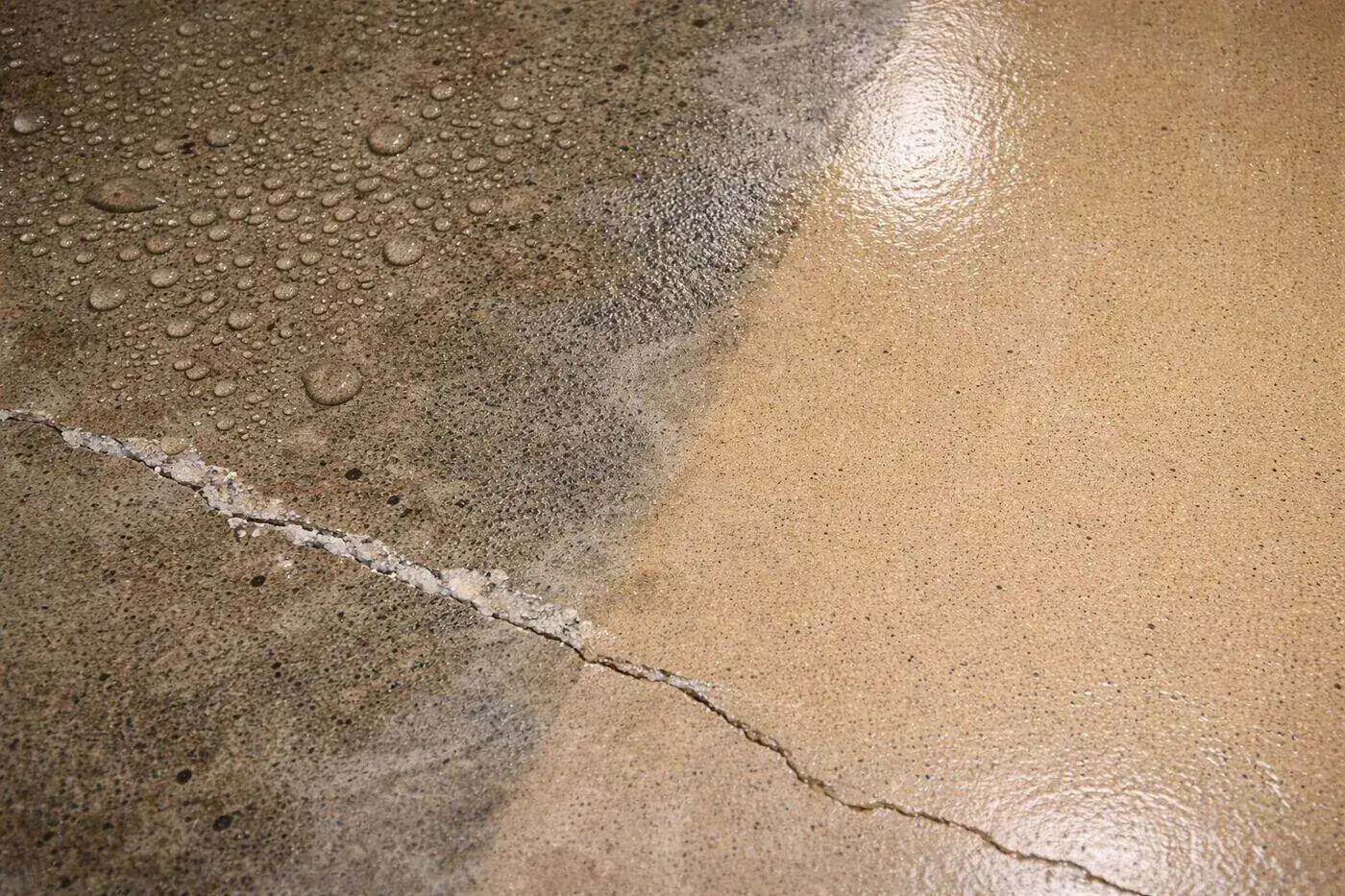
This is the line item that most separates a Melbourne quote from a national one, and it is the one budget contractors quietly skip. Much of Brevard County sits only a few feet above the water table, and in the barrier-island and lagoon-front neighborhoods from Satellite Beach and Indian Harbour Beach through Melbourne Beach and Indialantic, that table sits even closer to the underside of your slab, especially once the June-to-October rains roll in. Concrete in that situation wicks groundwater upward and pushes water vapor out through the surface, and that vapor will lift an epoxy coating off the slab from below no matter how well the top was prepped. That is why we run an ASTM slab-moisture test before we quote a price, not after. We offer that test free, a $200 to $400 value with most installers. If the reading comes back above the safe threshold, a moisture-mitigation primer becomes non-negotiable and adds roughly $1.50 to $3.00 per square foot. Skipping it to win the bid is the single most common reason epoxy floors bubble, blister, and delaminate on the Space Coast.
Polyaspartic Topcoats
Melbourne stays humid essentially year-round, and the heat keeps slab temperatures elevated even when the garage door is shut. Standard slow-cure epoxy fights those conditions: it can blush, cloud, or fail to fully harden when the air carries that much moisture during the cure window. That is the reason a serious local installer reaches for a polyaspartic or polyurea topcoat instead. These resins kick faster, shrug off humidity during the cure, and resist the ambering that plagues older epoxy. Specifying that topcoat over the same flake base adds roughly $1.50 to $3.00 per square foot, and in Melbourne it is the difference between a floor engineered for the climate it lives in and one that was simply poured and hoped for.
UV-Stable Topcoats
Melbourne sun is brutal on a coating, and it does its damage quickly. Leave the bay door up while you work, or run a floor through a sunroom or a glass-walled patio room, and a coating that is not UV-stable will yellow and chalk within a couple of seasons. A UV-stable topcoat is not an upgrade here, it is the default spec, and it is built into the polyaspartic and polyurea systems we recommend. Yes, it sets the baseline price above what a contractor in a cloudy northern market could get away with charging, but it is exactly what keeps a Melbourne floor reading crisp and new instead of looking sun-bleached a year in.
Salt Air
This is the Melbourne driver that does not exist for an inland market at all. Salt drifts inland off the Atlantic and the Indian River Lagoon across the barrier-island and waterfront communities from Cocoa Beach and Cape Canaveral down through Satellite Beach, Indian Harbour Beach, and Melbourne Beach, and it works on coatings at the edges, the control joints, and any open bay over time. On a closed interior garage a few blocks back it is a minor factor. On a boat-owner's open garage, a dockside workshop off a Merritt Island canal, a lanai or pool deck, or a lagoon-front home, it is a real one, and the spec shifts toward thicker, more chemically resistant builds with a UV-stable topcoat. If your slab is anywhere near the water, expect that to show up in what we recommend.
Put plainly: between the water table, the salt, the heat, and the sun, the right floor in Melbourne is rarely the cheapest one on the quote pile. Those four drivers lift the baseline spec, which is why the entry price here sits above a dry inland market, and every dollar of it goes into the prep and topcoat that actually make the floor last. For the deeper version of why coastal slabs fail and the test that heads it off, read our companion guide on why epoxy floors fail in Brevard County and the moisture test that prevents it.
Matching the Finish to How You Use the Space
The right finish is mostly a question of how the space gets used and how much you want it to look like a feature. A quick way to place yourself:
- Function over flash: a storage garage or workshop is happy with solid color at $5 to $7 a foot. Sealed, glossy, washable, no decorative premium.
- The default Melbourne garage: flake at $6 to $9 a foot wins for a reason. It camouflages marks, grips when wet, and looks finished, and with a polyaspartic topcoat over it, nothing else matches it for value in this climate.
- A room you want to show off: metallic at $9 to $12 a foot turns the floor into the centerpiece. The call for waterfront living spaces and design-driven interiors.
- Hard use and wet floors: quartz at $10 to $12 a foot is the toughest, grippiest system going, and the standard spec for commercial kitchens, clinics, and locker rooms.
If you are a typical Melbourne homeowner coating a garage and you want one recommendation, it is a full flake broadcast under a polyaspartic topcoat. That pairing hits the balance of looks, toughness, and the humidity-and-UV armor a coastal slab needs.
Five Line Items a Melbourne Quote Must Spell Out
A dollar-per-foot figure is meaningless if it quietly leaves out the work that makes a coastal floor survive. Before you compare estimates, make sure each one spells out all five of these so you are weighing the same job, not a real floor against a shortcut:
- The slab-moisture test. In Melbourne this is the make-or-break step, not a formality. A serious installer tests your concrete before naming a price. If a company does not bring it up, ask point-blank, and be wary if they wave it off.
- How the slab gets prepped. The answer should be a mechanical diamond grind, not an acid etch. The quote should name the prep method in writing.
- Crack and spall repair. Wider cracks and surface spalling should be cut, filled, and leveled before any coating goes down. Confirm it is in scope, not an add-on found later.
- The complete coating system. A base coat, the decorative layer, and a UV-stable polyaspartic or polyurethane topcoat. One thin coat of roll-on product is not a system and will not hold here.
- The all-in total. Compare the finished project number, not the headline per-foot rate, because the prep and the topcoat are precisely where a cheap bid hides its cuts.
When one estimate lands far below the rest, the gap is almost always the missing work, not a better deal: no moisture test, an acid wash instead of a grind, watered-down consumer-grade resin, and no real topcoat. Those omissions save you money for about a year, then cost you the entire floor. A properly installed epoxy floor should give you 10 to 20 years in a Melbourne home, so the prep that drives the price is what you are actually buying.
Frequently Asked Questions
How much does epoxy flooring cost in Brevard County?
By finish, installed in 2026, Melbourne epoxy runs about $5 to $7 per square foot for solid color, $6 to $9 for flake, $9 to $12 for metallic, and $10 to $12 for quartz. For a real-world anchor, a base flake floor on a standard two-car garage lands between $2,000 and $4,000 all in, and that same bay with a polyaspartic topcoat over the flake lands between $4,000 and $5,500; both include the moisture test, diamond grind, and a climate-rated finish.
Why does epoxy cost more in Melbourne than the national average?
Three coastal conditions raise the baseline spec: a high water table that the summer rains push higher, year-round humidity, and harsh sub-tropical sun. Many Melbourne slabs need a moisture-mitigation primer (about $1.50 to $3.00 per square foot) under a humidity-tolerant, UV-stable polyaspartic topcoat. That prep is exactly what keeps the floor stuck down, so the entry price sits above a dry inland market.
How much does a 2-car garage epoxy floor cost in Brevard County?
A typical Melbourne two-car garage is 400 to 500 square feet. A quality flake system runs $2,000 to $4,000, covering the slab-moisture test, a full diamond grind, crack and spall repair, the base coat, and the flake broadcast. Add a protective polyaspartic or polyurethane topcoat over that flake and the same bay runs $4,000 to $5,500. Step up to a hand-poured metallic and the total rises toward $5,500 to $7,500.
Does my Melbourne slab need moisture mitigation before epoxy?
Often, yes, and more so near the canals and coast. With Melbourne sitting so close to the water table, many slabs push enough vapor up through the concrete to lift a coating from below. We run a free ASTM moisture test before quoting; if the reading is above the safe threshold, a moisture-mitigation primer is mandatory. With most other installers that test alone is a $200 to $400 value.
Which epoxy finish is the best value for a Melbourne garage?
For most Melbourne homeowners coating a garage, a full flake broadcast sealed with a polyaspartic topcoat is the sweet spot at $6 to $9 per square foot. It hides marks, grips when wet, looks finished, and carries the humidity and UV protection a coastal slab demands.
How long should a professionally installed epoxy floor last in Brevard County?
With a proper diamond grind, moisture mitigation where the test calls for it, and a UV-stable topcoat, expect roughly 10 to 20 years in a home and 5 to 10 years in a commercial setting. The early failures you hear about in Florida come from skipped prep, not from the coating technology itself.
Get Your Personalized Brevard County Epoxy Quote
Ranges and reasoning will only get you so far. The only way to know your real number is to have someone stand on your slab, run the moisture test, and look at the actual condition of the concrete. Every Alpha Epoxy Melbourne estimate starts exactly there: a hands-on look, an ASTM moisture reading, and a straight conversation about which finish fits your space and your budget. No high-pressure close, no quote that balloons on install day, just one clear number and a system built for a coastal Space Coast slab. Have a question after hours? We answer 24/7.
Ready for your number? Call (321) 384-1698 or request a free quote online. We coat floors across Melbourne, Satellite Beach, Palm Bay, West Melbourne, Viera, Merritt Island, Indialantic, Rockledge, Titusville, and the surrounding Brevard County communities.